
Disclosure: This post may contain affiliate links. If you purchase through these links, we may earn a small commission at no extra cost to you. We only share products and resources we genuinely use and love.
Morning Chaos
My son has always been a very active kid. Sitting still? Not his thing. Staying on one task? Also not his thing.
Mornings used to feel like a constant loop of instructions:
Eat breakfast. Brush your teeth. Get your backpack. Why are you reading a book right now? Why is there LEGO on the floor?
It was frustrating for him because I sounded demanding.
It was exhausting for me because I was tracking time, tasks, and his focus all at once.
Then I read something in a book (I promise I’ll update this once I remember which one 😅) that completely shifted my perspective:
ADHD often comes with time blindness.
That sentence made everything click. For my son, it wasn’t “10 minutes until we leave. ”It was now… until suddenly it was time to go.
If you’ve ever heard:
I’ll do it later.
Homework isn’t due until Friday.
Why do it now?
I was just about to do it!
…this might be why.
The Checklist Shift
What finally helped us was removing me as the task manager.
Instead of telling him what to do next, I created a simple checklist. My only job became saying: “Check the list.”
The responsibility shifted to him.
Did it work perfectly right away? Absolutely not.
Most mornings still include:
“The checklist, please.”
A few complaints (I give early-morning grace).
Some wandering focus.
But something incredible happened.
By the second or third week, he said:
“Mom, I don’t think I need the list anymore. I remember it now. Let’s keep it here just in case.”
Now he finishes getting ready in his own order, at his own pace, and then checks the list at the end to make sure nothing was missed.
No constant reminders.
Less frustration.
Way more confidence.
And the pride on his face when he realized he could do it himself? Worth everything.
What About Time?
We’re still working on that part. His therapist recommended using a visual timer— and set it for him to track his time, something like: “You have 30 minutes to be ready with shoes on by the door.”
At first, he refused to use it.
“That timer makes time go faster!”
And honestly? That one was on me.
Before the timer, I’d say he had 10 minutes… then let it stretch to 20.
The timer isn’t flexible like Mom is.
When time is up, it’s up.
He didn’t like that—but we’re learning together.If you want to try a timer, I use a simple visual one (I’ll link the one we use). I even use it myself in the kitchen sometimes. Turns out adults benefit from time awareness too.
Our Daily Setup
We have:
One Morning Routine checklist
One Afternoon/Evening Routine checklist I printed them, glued them onto a piece of an Amazon shipping box, and turned them into little boards.
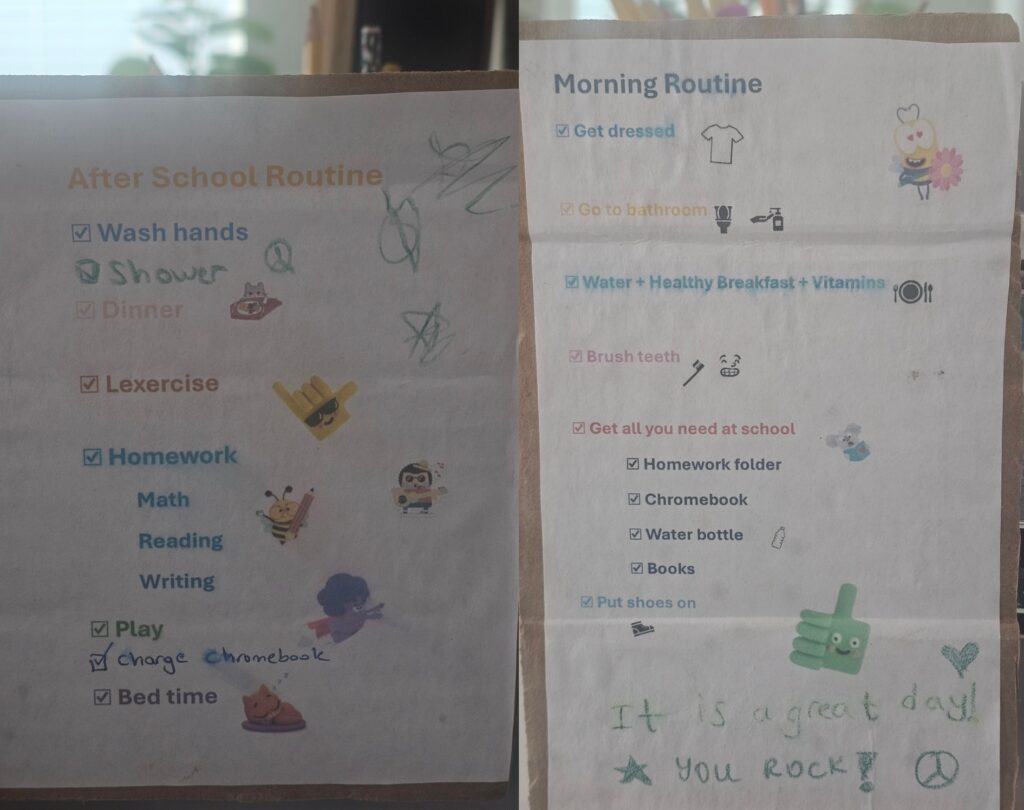
Nothing fancy.
Nothing expensive.
But we use them every single day.
They’ve helped reduce power struggles, boosted independence, and made our mornings feel calmer—for both of us.
If mornings feel hard in your house, give this a try. And if you do, I’d love to hear how it goes. 💛