
I have mixed feelings about positive affirmations.
I like the idea behind them. I want my son to have a kind voice in his own head. I want him to believe in himself and not immediately think I can’t do this when something feels hard.
But some affirmations have always felt a little strange to me.
I am amazing.
I am the smartest.
I am beautiful.
I can do anything.
They’re positive, sure. But do kids actually believe them?
Because if my child is struggling with something and genuinely thinks he can’t do it, I’m not sure having him repeat “I can do anything!” ten times is going to suddenly convince him otherwise.
And honestly, I don’t really want it to.
I’d Rather Praise the Trying
I’ve always been more interested in praising effort, trying and progress than things like you’re so smart, you’re so talented or you’re so handsome.
Of course I tell my son wonderful things about himself. I’m his mom. 😄
But when something actually matters, I try to notice what he did.
You kept trying even though that was hard.
You didn’t know how to do that before, and you figured it out.
You were nervous and you still tried.
You made a mistake and went back to fix it.
Because “I’m smart” doesn’t give you much to work with when suddenly something isn’t easy.
But:
I can try again.
I can ask for help.
I don’t have to know how to do everything yet.
Those feel different to me.
They’re not telling a child that everything will be easy. They’re reminding them that they have tools when it isn’t.
I Don’t Want Positive Thinking to Become Toxic Positivity
This is probably the biggest reason I’m careful with affirmations.
I don’t want positivity to mean pretending uncomfortable feelings aren’t there.
If my son is scared, I don’t want him saying:
I’m not scared.
Because…he is.
And that’s okay.
I’d much rather he learn:
I can feel scared and still try.
If something is really difficult, he doesn’t need to pretend it’s easy. If he’s sad, frustrated, jealous, nervous or disappointed, I don’t want him thinking those are somehow the wrong feelings to have.
Positive self-talk shouldn’t erase reality.
For me, it’s more about what comes after we acknowledge reality.
This is hard.
But I can take it one step at a time.
I made a mistake.
But I can learn from it.
I don’t know how to do this.
But I can ask for help.
That’s the kind of positivity I want him to carry with him.
Eventually, I’m Not Going to Be the Voice in His Head
I think about this sometimes.
Right now, I’m there to remind him that one bad grade doesn’t mean he’s bad at something. I can point out how much he’s improved or remind him that he’s done hard things before.
But I’m not always going to be standing next to him.
Eventually, I want some of that language to become his own.
Not “I’m perfect.”
Not “I’m the best.”
More like:
I can figure this out.
I can try again.
It’s okay to ask for help.
I’m still learning.
Maybe that’s what I actually like about affirmations—the possibility that, after hearing something enough times, it becomes part of the way a child talks to himself.
So Why Coloring Pages?
When I started putting together affirmation cards, I also made coloring pages with some of the same messages.
Partly because my son is not going to sit across from me every morning repeating affirmations like we’re at a motivational seminar. 😄
That would last approximately two days.
But coloring is different.
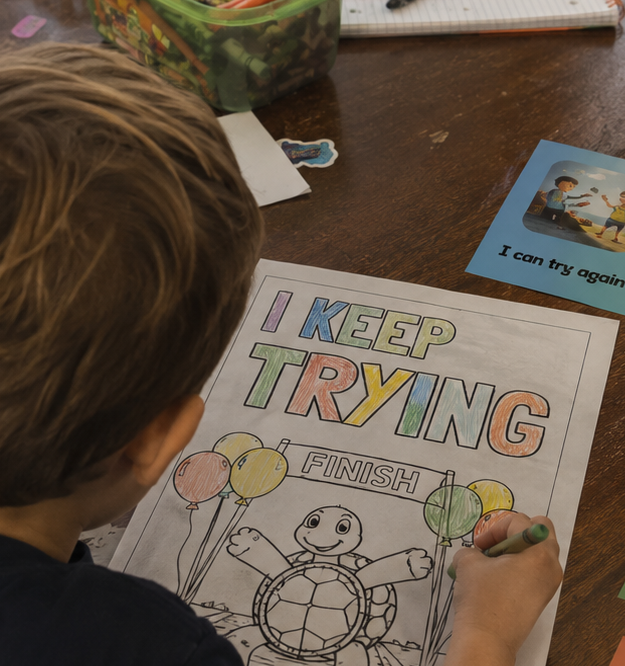
There’s no big lesson required. A child can color while the words are simply there.
Maybe they read them. Maybe you talk about one. Maybe you ask, “What do you think this one means?”
Or maybe they just color.
That’s okay too.
I don’t want emotional resilience to become another subject kids have to study.
Keep It Simple
I don’t think kids need to repeat twenty affirmations every morning.
Sometimes we can just choose one that fits what’s happening.
Before trying something new:
I can be brave even when I feel nervous.
After making a mistake:
Mistakes help me learn.
When something feels overwhelming:
I can take it one step at a time.
And sometimes there doesn’t need to be a reason at all. Leave a card on a desk. Put one near the bathroom mirror. Let your child choose one they like. Color one together.
The Kind of Confidence I Want to Build
I don’t know if repeating “I am smart” makes a child more confident.
But I do think there’s something powerful about a child gradually learning:
I don’t have to be good at something immediately.
Trying matters.
Making mistakes doesn’t mean I failed.
I can be nervous and still be brave.
That’s the confidence I’m more interested in.
Not confidence that comes from believing I’m great at everything.
Confidence that says:
Even when I’m not great at something yet, I’ll be okay.
Maybe that’s what positive affirmations can be when we take away the pressure to be positive all the time.
Not pretending. Not constant praise.
Just practicing a kinder, more useful way of talking to ourselves.
If You Want to Use the Ones I Made
I created my affirmation cards and coloring pages around the kinds of messages I actually want my son to hear—more about effort, courage, learning, trying and self-kindness, and less about being the smartest, the best or always feeling positive.
I added them to my Etsy shop in case another parent, teacher or caregiver wants to use them too.
→ Here’s our Positive Affirmation Cards & Coloring Pages
But however you introduce positive self-talk, I think the message underneath it matters more than the exact words:
You don’t have to believe you’re amazing at everything. You just have to believe you’re capable of trying.