Do I know what I feel?
I read somewhere recently that a lot of people aren’t actually very good at identifying exactly what they’re feeling.
At first I thought, of course I know what I’m feeling.
Then I actually paid attention.
Happy, sad, angry? Sure. But when life gets busy or there are several things going on at once, it gets more complicated. Am I frustrated? Overwhelmed? Anxious? Disappointed? Just tired? Sometimes it’s a combination of several things and I don’t immediately have a name for it.
And I’m an adult.
It made me think about how much harder that must be for kids.
When a Big Feeling Just Feels… Big
My son has always had big feelings.
When he was younger, the feeling itself could almost make him panic. He wasn’t only angry, frustrated or upset. He seemed overwhelmed by the fact that he was feeling that way.
And once he got there, trying to talk logically about it wasn’t particularly useful.
Calm down.
Okay…but how?
Tell me what’s wrong.
He didn’t always know.
We eventually started using a simple feelings chart. The first step was just helping him figure out what he was actually feeling.
When everything feels huge, even being able to point to a picture and say this one can help.
It wasn’t an overnight transformation. We used it, talked about feelings, forgot about it, came back to it. But over time, I noticed that he was getting better at recognizing what was happening.
Instead of everything simply being BAD, there was a little more language around it.
I’m frustrated.
I’m nervous.
I’m disappointed.
That might sound like a small thing, but I don’t think it is.
Because once you have some idea of what you’re dealing with, you can start figuring out what to do with it.
What Helped Us
After identifying the feeling, we worked on what he could actually do when he felt that way.
Take a few deep breaths. Get some space. Talk to someone. Move your body. Ask for help. Sometimes just wait.
Over time, I think he started making the connection between the two:
This is what I’m feeling, and this is something I can do when I feel this way.
It didn’t mean the big feelings disappeared. They didn’t. And honestly, I don’t think that’s the goal.
The difference was that the feeling itself became less scary. He started understanding what was happening and, little by little, learning that he could handle it.
And there was one other thing we kept reminding him:
This will pass. You won’t feel this angry forever. You won’t be this frustrated forever. You won’t always feel as sad as you do right now.
I really want him to understand that.
You can be upset. You can cry. You can be angry. You don’t have to immediately make an uncomfortable feeling disappear.
But you can recognize it, let yourself feel it and use the things you know help you get through it.
And then it passes.
We’re Not Trying to Get Rid of Big Feelings
I think this is probably the biggest thing I’ve learned from all of this.
The goal isn’t to raise a child who doesn’t get angry, frustrated, nervous or sad.
That’s not realistic. And I don’t think it would be particularly healthy either.
What I want is for him to eventually be able to think:
I know what this is. I can handle it. It won’t feel like this forever.
Honestly, that’s something I’m still learning myself.
I still don’t always know exactly what I’m feeling. Sometimes I have to stop and think about it.
And maybe that’s okay.
We don’t have to perfectly identify every emotion the second it appears. I think it’s more about learning to notice what’s happening instead of immediately being overwhelmed by it.
What am I feeling?
How big is it?
Why might I be feeling this way?
What could help me right now?
Those are skills that take time.
What I Would Do Differently Now
Looking back at what worked for us, I realized I wanted a little more than the feelings chart we originally used.
That’s eventually how I ended up creating my own four-page set.
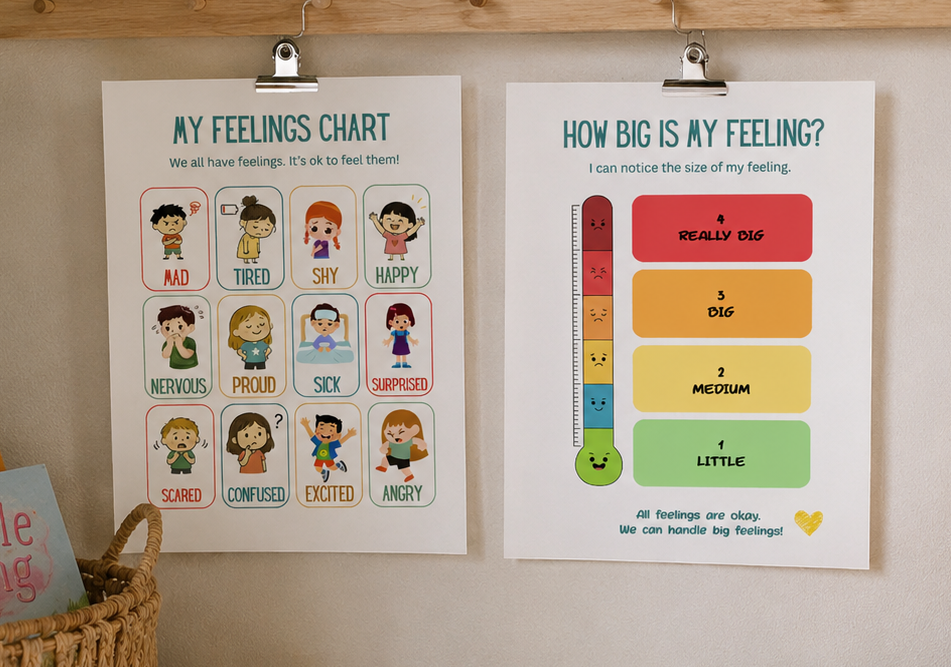
The first page is a Feelings Chart. That’s the starting point: What am I actually feeling?
The Feelings Check-In takes it a little further, in case you want to dig deeper. What does my body feel like? Why might I be feeling this way? What might help? I wanted kids to start connecting the emotion to what’s actually happening inside them, rather than just learning the names of emotions.
The What Can Help Me? page gives them simple choices for the moments when coming up with a solution on their own is hard. Take some deep breaths. Talk to someone. Move your body. Ask for help. Take a quiet break. Draw or color. Read. Get some water. Go outside.
Nothing groundbreaking. Just simple things kids can actually do.
And finally, there’s a How Big Is My Feeling? scale from 1 to 4.
Not every feeling needs the same response. Being a little annoyed is different from being completely overwhelmed. And sometimes saying “I’m at a 4” is much easier for a child than trying to explain everything that’s going on inside their head.
Just Tools That Helped Us
None of these pages are magic solutions. I definitely don’t have one of those. 😄
They’re simply based on things that helped us over time and things I wish we’d had together when we first started trying to navigate those big feelings.
I put them together hoping they might make the process a little easier for another parent, teacher or child too.
If you’d like to use the set, you can find a set in my Etsy Shop: Feelings & Emotions Printable Set.
But whether you use a chart, draw the feelings yourself, talk about them in the car, or come up with your own system, I think the important part is the same.
Big feelings don’t have to be scary.
They come. We feel them. We figure out what we need.
And eventually, they pass.